
Job Search Depression Is Real — Here Is What Actually Helps
Nobody talks about it honestly enough. A long job search can make you feel like you’re sinking — not just professionally, but personally. The energy you once had for the process fades. The optimism dries up. Some days, just opening your laptop feels like more than you can handle.
If that sounds familiar, you’re not imagining it. And you’re not weak for feeling it.
The emotional weight of job search depression is real, well-documented, and far more common than most people admit. It doesn’t mean something is wrong with you. It means you’re a human being going through one of the most stressful experiences modern life can throw at someone.
Why Job Searching Hits So Hard
The job search is uniquely structured to challenge your emotional stability. It combines several of the most stressful psychological factors into one extended experience: uncertainty about the future, loss of daily structure, repeated rejection, financial pressure, and the erosion of professional identity.
Any one of those would be hard on its own. Together, they create a weight that builds quietly, day after day, until it’s hard to see a way through.
What makes it worse is the isolation. Most people don’t talk openly about how the search is going —‚ especially when it’s not going well. So you end up carrying the weight alone, comparing your worst days to everyone else’s highlight reel, and wondering why this seems so much harder for you than it is for anyone else.
It’s not harder for you. It’s hard for everyone. You’re just not seeing their version of it.
And here’s the thing that matters most right now: the fact that you’re still in this — still reading, still looking for a way through — says something about who you are. The weight is real. But so is your capacity to carry it.
The Emotional Spiral Is Not Unexpected
Here’s something that helps to understand: the emotional pattern that a long job search takes us on is predictable. It’s not a sign that you’re failing. It’s a pattern that most people move through.
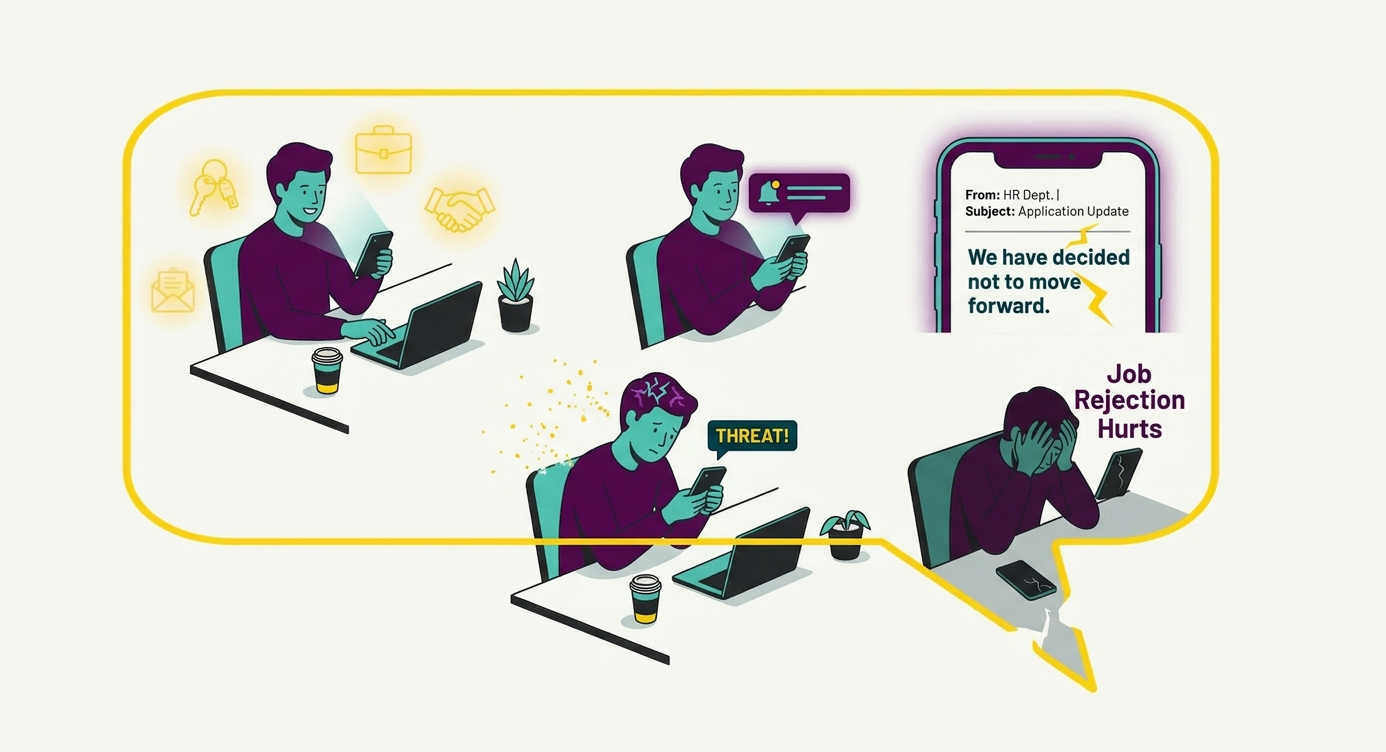
It usually starts with energy and optimism — the fresh resume, the belief that something good is just around the corner. Then comes the middle stretch, where applications go unanswered and the silence starts to wear. That middle stretch is where things get heavy. The self-doubt creeps in. The motivation drops. The days start to blur.
Understanding that this arc is normal doesn’t erase it. But it takes some of the sting out. You’re not falling apart. You’re experiencing what happens when effort meets prolonged uncertainty. That’s a human response, not a personal failure. And it means the system is working the way it’s supposed to — you just happen to be inside a hard part of it right now.
Research on the science of encouragement shows that small, well-timed prompts can interrupt these downward spirals. You don’t need a dramatic intervention. You need the right reframe at the right moment — something that breaks the loop long enough for you to take one more step. That’s a smaller ask than it sounds like, and it works more often than you’d expect.
What Actually Helps
There’s no silver bullet. But there are a few things that consistently make a difference for people working through the emotional toll of a long search. None of them require superhuman effort. Most of them are things you can start today.
Keep a structure. When external structure disappears — no commute, no meetings, no deadlines — internal structure becomes critical. Wake up at a consistent time. Block off time for the search. Build in time for things that aren’t the search. Structure won’t fix everything, but it gives your days a shape that prevents free-fall.
Move your body. This isn’t motivational fluff. Physical movement changes your neurochemistry in real time. A twenty-minute walk can shift your mood more effectively than two hours of rumination. You don’t have to train for a marathon. You just have to move.
Limit your exposure. Social media during a job search is a minefield. Every LinkedIn announcement of someone else’s new role can feel like a personal indictment. If scrolling makes you feel worse, stop scrolling. You’re not missing anything that matters more than your mental state.
Stay connected to people. The instinct to withdraw is strong, but isolation makes everything heavier. You don’t need to talk about the search with everyone. But staying connected to people who care about you — even in small, casual ways — keeps you tethered to a reality that’s broader than your inbox.
Set boundaries on the search itself. One of the most destructive patterns is letting the job search take over your entire day, every day. Decide when you’ll start, when you’ll stop, and what you’ll do afterward. The daily routine you build is your most powerful protective tool. And giving yourself permission to step away isn’t quitting — it’s how you make sure you can come back tomorrow.
Small Wins Are Not Small
When you’re in a low stretch, the idea of celebrating “small wins” can feel patronizing. You don’t want small wins. You want a job offer. That frustration is completely valid.
But here’s what the research tells us, and what people who’ve been through long searches will confirm: small wins build momentum in ways that matter — not because they solve the problem, but because they interrupt the narrative that nothing is working. And that narrative is the real enemy, not the job market.
A small win might be completing one strong application. Having a good conversation with a former colleague. Getting a response — even a rejection — after weeks of silence. Finishing a course. Updating a section of your portfolio.
None of those things are the finish line. But each one is evidence that you’re still moving. And when everything feels stuck, evidence of movement is exactly what your brain needs. You’re doing more than you think. The search just doesn’t give you credit for it in real time.
✨ This is hard. Not because you’re doing it wrong — because it is hard. Keep going.
Your mindset matters — and so does the right support.
Hireground sends you short, science-backed encouragement texts designed for real job seekers. On the hard days, the right message at the right moment changes everything.
Get Daily Encouragement → No spam. Cancel any time.When to Reach Beyond the Search
There’s an important line between the normal emotional weight of a job search and something that needs more support than a routine adjustment can provide.
If you’re struggling to get out of bed most days, if you’ve lost interest in things that used to matter to you, if the weight feels like more than situational frustration — those are worth paying attention to. Talking to a professional isn’t a sign of failure. It’s one of the smartest things you can do when the weight gets too heavy to carry alone.
A job search is a season. It ends. But taking care of yourself during that season isn’t optional — it’s what makes it possible to come out the other side still intact.
You’re Still in This
The hardest part of a long search isn’t the logistics. It’s the way it makes you feel about yourself. The silence, the rejection, the uncertainty — they all conspire to tell you a story that isn’t true.
The story says you’re not good enough. That you should have figured this out by now. That everyone else has it together and you don’t.
That story is convincing. But it’s not accurate. You’re in a hard season, doing hard things, with fewer visible results than you deserve. That doesn’t mean you’re failing. It means you’re in the middle.
And the middle is where most people are when they feel like giving up. Which is exactly why the next step matters more than any of the ones that came before it. You’ve already proven you can take hard steps. The next one doesn’t have to be big. It just has to be forward.
Questions People Ask About Job Search Depression
Very normal. The combination of uncertainty, rejection, loss of routine, and financial pressure creates a level of emotional strain that most people underestimate. Feeling down during this process doesn’t mean something is wrong with you — it means you’re going through something genuinely hard.
Frustration tends to be situational — it comes and goes based on what’s happening in the search. If you’re experiencing persistent low mood, loss of interest in things you usually enjoy, significant changes in sleep or appetite, or difficulty functioning most days, it’s worth talking to a professional for guidance.
Focus on what you can control today, not the outcome you can’t. Set one small goal for the day and stop when you’ve done it. Staying in motion — even slowly — is more important than maintaining a specific pace.
Yes. Physical activity directly affects mood-regulating chemicals in the brain. Even short walks or light exercise can reduce feelings of anxiety and improve your ability to focus. It’s one of the most consistently supported interventions for stress management.
If the emotional weight of the search feels like more than frustration, talking to someone — whether a trusted friend, a mentor, or a professional — can make a real difference. You don’t have to carry the full weight alone, and reaching out is a sign of strength, not weakness.
Research on ecological momentary interventions shows that brief, well-timed prompts can interrupt negative thought cycles and help people regain emotional footing. It’s not about solving the problem — it’s about breaking the spiral long enough to take the next step.
Spark Micro Messages is a personal development and encouragement service. It is not therapy, counseling, or crisis support. If you’re experiencing a mental health challenge, please reach out to a qualified professional.